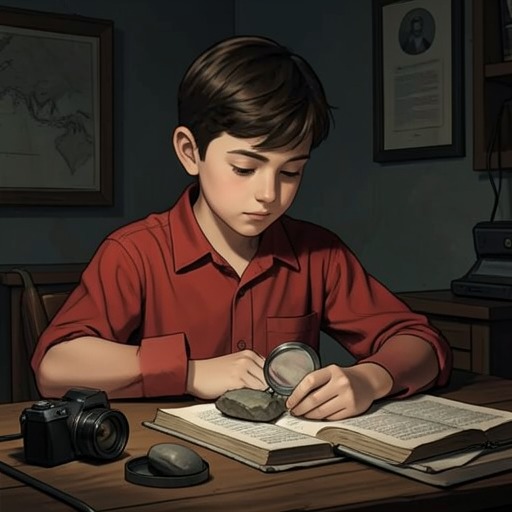
Memory like a movie
The Curious Incident of the Dog in the Night-TimeChristopher’s “memory as film” is a model of memory as an unusually accessible record of events, not a loose collection of impressions. He describes being able to revisit a scene, pause or move through remembered material, and retrieve details such as conversations, clothing, and smells. The model clarifies both his strengths as an observer and the practical way he uses remembered examples to navigate uncertain situations.
The Recorded Scene
Christopher says that his memory works like a film and links it to his ability to remember conversations written down in his book, what people wore, and what they smelled like. He calls its olfactory component a “smelltrack,” by analogy with a soundtrack. Rather than treating recollection as a vague impression, he presents it as information preserved in distinct scenes, with details available for later inspection.
His account of replaying memories borrows the controls of video and DVD players: he can rewind, fast-forward, and pause. The comparison has an important qualification. Reaching an older memory does not require him to rewind through everything that happened in between; there are no literal buttons, because the process takes place in his mind. The mechanical analogy conveys accessibility and control while remaining a figure for an inward mental process.
When asked what his mother was like, Christopher explains that he can rewind to multiple scenes and describe her as she appeared in each one. His example is a specific day on holiday in Polperro, Cornwall: on 4 July 1992, when he was nine, he remembers his mother on the beach, what she wore and read, and her invitation to enter the water. When she disappeared beneath it, he feared a shark had taken her; she surfaced, held out her hand, and reassured him. The remembered episode is not merely a catalogue of details: it preserves an interaction in which his mother’s response helped him feel better.
Memory as a Practical Search
The film model also describes how Christopher identifies people. When he does not know who someone is, he notices features such as clothing, a walking stick, unusual hair, glasses, or a characteristic way of moving the arms. He then searches memory for a match. Recognition is presented as a process of observation followed by comparison, rather than an unexplained intuition.
The same method helps him decide how to act in difficult situations. If someone uses an expression that does not make sense to him, he searches memory to find whether he has heard it before. More consequentially, if someone at school is lying on the floor, he compares the scene with remembered pictures of an epileptic fit. If he judges that the person is having a fit, he moves furniture away, puts his jumper beneath the person’s head, and finds a teacher. Here memory is not only a record of the past: it supplies a model for interpreting the present and choosing a response.
Christopher makes a further distinction between his own mental pictures and other people’s. In his account, his pictures represent things that really happened, whereas other people can picture things that did not happen. His mother’s imagined alternative life—a farmhouse in the south of France with a local handyman—and Siobhan’s imagined stay on Cape Cod with a friend, followed by a boat trip to watch humpback whales, illustrate the contrast. Their imagined scenes can offer comfort or happiness, but Christopher does not classify them as records of actual events.
Limits and Narrative Importance
The system has a stated boundary: Christopher cannot remember anything from before he was about four, because he says he was not yet looking at things in the right way for them to be recorded properly. The recording metaphor therefore does not claim complete access to the past. It gives an account of how memory works for him while acknowledging a period that was not preserved in a usable form.
The novel places this explanation beside Christopher’s detective work, where he weighs the possibility that a garden fork is a misleading clue and reasons toward a prime suspect, and beside his later discovery of an unopened letter addressed to him. The postmark establishes that the letter was sent on 16 October 1997, eighteen months after he had been told his mother was dead. Eventually, his father confesses to killing Wellington. These events are not all presented as memories, but they sharpen the distinction between remembered evidence and conclusions drawn from it: Christopher’s confidence in recorded details does not make every interpretation infallible, and what he knows can change when new evidence emerges.
As a description of cognition and a principle of narration, the film metaphor makes scenes and their particulars central to Christopher’s account. The ability to retrieve specific moments helps him explain people, recognize patterns, and act in emergencies; the contrast with imagined pictures also marks a difference between his way of representing experience and that of those around him. Memory is both archive and tool, but it remains bounded by what was recorded and subject to revision when evidence changes.